The 4Cs of Diamond Grading
Many people are confused about how diamonds are priced. The best explanation is that asking for the price of a diamond is like asking for the price of a house. A real estate agent can’t quote you a price for a house without knowing its size, condition, location, etc. This process is the same one used when buying a diamond. A diamond’s beauty, rarity, and price depend on the interplay of all the 4Cs—carat, clarity, color, and cut.
The 4Cs are used throughout the world to classify the rarity of diamonds. Diamonds with the combination of the highest 4C ratings are more rare and, consequently, more expensive. No one C is more important than another in terms of beauty and it is important to note that each of the 4Cs will not diminish in value over time. Once you have established those 4C characteristics that are most important to you, a jeweler can then begin to show you various options with quoted prices.
The Diamond Quality Pyramid is a diamond grading framework to help you compare diamonds. While most diamonds are precious, those closest to the top of the pyramid—possessing the best combination of carat weight, clarity, color and cut — are the earth’s rarest and most valuable.
CARAT: Refers to the weight of a diamond.
Carat is often confused with size even though it is actually a measure of weight. One carat is equivalent to 1/5 of a gram or 200 milligrams. Thus 5 carats equals one gram. One carat can also be divided into 100 “points.” A .75 carat diamond is the same as a 75-points or 3/4 carat diamond.
A 1-carat diamond costs more than the price of a half-carat diamond, right? Wrong, Size can not dictate price alone, without taking the other 3Cs into consideration. Since larger diamonds are found less frequently in nature, which places them at the rarest level of the Diamond Quality Pyramid, a 1-carat diamond will cost more than twice* that of a 1/2-carat.
(* assuming color, clarity and cut remain constant).
Cut and mounting can make a diamond appear larger (or smaller) than its actual weight. So shop around and talk to your jeweler to find the right diamond and setting to optimize the beauty of your stone.
CLARITY: Refers to the presence of inclusions in a diamond.
Inclusions are natural identifying characteristics such as minerals or fractures, appearing while diamonds are formed in the earth. They may look like tiny crystals, clouds, feathers, graphite, or mineral
To view inclusions, jewelers use a magnifying loupe. This tool allows jewelers to see a diamond at 10x its actual size so that inclusions are easier to see. The position of inclusions can affect the value of a diamond. There are very few flawless diamonds found in nature, thus these diamonds are much more valuable because of their rarity.
Inclusions are ranked on a scale of perfection, known as clarity, which was established by the Gemological Institute of America (GIA).
The clarity scale, ranging from F (Flawless) to Included (I), is based on the visibility of inclusions at a magnification of 10x.
Some inclusions near the girdle can be hidden by the mounting, covering the inclusion and adding to the beauty of the diamond. An inclusion in the middle or top of a diamond could impact the dispersion of light, sometimes making the diamond less brilliant.
The greater a diamond’s clarity, the more brilliant, valuable and rare it is—and the higher it is on the Diamond Quality Pyramid.
COLOR: Refers to the degree to which a diamond is colorless.
Diamonds range in color from icy winter whites to warm summer whites. Diamonds are graded on a color scale established by the Gemological Institute of America (GIA) which ranges from D (colorless) to Z (yellowish-brown).
Warmer colored diamonds (I – M) are particularly desirable when set in yellow gold. Icy winter whites (D – G) look stunning set in white gold or platinum.
Color differences are very subtle and it is very difficult to see the difference between, say, an E and an F. Therefore, colors are graded under controlled lighting conditions and are compared to a master set for accuracy.
Truly colorless stones, graded D, treasured for their rarity, are highest on the Diamond Quality Pyramid. Color, however, ultimately comes down to personal taste. Ask a jeweler to show you a variety of color grades next to one another to help you determine your color preference.
CUT: Refers to the angles and proportions of a diamond.
Based on scientific formulas, a well-cut diamond will internally reflect light from one mirror-like facet to another and disperse and reflect it through the top of the stone. This results in a display of brilliance and fire, thereby placing well cut diamonds higher on the Diamond Quality Pyramid than deep or shallow-cut diamonds.
Diamonds that are cut too deep or too shallow lose or leak light through the side or bottom, resulting in less brilliance and ultimately, value.
Cut also refers to shape — round, square, pear, or heart for example. Since a round diamond is symmetrical and capable of reflecting nearly all the light that enters, it is the most brilliant of all diamond shapes and follows specific proportional guidelines. Ask a jeweler to find out more about these guidelines.
Non-round shapes, also known as “fancy shapes,” will have their own guidelines to be considered well -cut.
What to Spend:
When you start to think about buying a diamond—and the love it will symbolize—you naturally want the best you can afford and a beautiful stone you will treasure forever.
Diamonds can be found in a range of prices and you’re certain to find one within the Diamond Quality Pyramid that suits your taste and what you plan to spend on a diamond that will truly represent your deepest emotions and the promise for the future you both will share.
Buying Diamonds Online … Beware
Most websites do not hand-pick or see the diamonds they carry, they just sell paper certificates, you have to see the stone! Diamond websites contain vast lists of diamonds that are uploaded automatically and can vary vastly in quality in addition be very confusing to most customers.
For example, you type in a specific set of criteria and it comes up with a list of diamonds that vary wildly by price … if the stone has a similar size, clarity, and colour grade why is there such a variance in price?
– because a diamond price is usually indicative of the quality of the stone … you get what you pay for!
Also, a lot of diamonds just look different, regardless of how they’re graded. The grading system is helpful to get started and to point yourself in the right direction, but anybody who’s looked at a lot of diamonds will tell you that it can’t replace actually judging a diamond in person. If you want proof of that, try visiting one of the large online diamond websites and do a search among the round diamonds, and search as specific as possible, limiting yourself to only one option in each grading category. You’ll get a long list of diamonds that vary a great deal in price. The range in price shows just how much the value can differ aside from the 4 C’s.
Without knowing what makes a diamond different from another you are at a huge disadvantage which favours the seller.
A common misconception that a lot of customers have is that you can compare diamonds by just comparing the main grading categories on the certificate alone. There are a lot of factors that you would overlook. For example:
- the cut and proportions of the diamond can be very different from what’s stated and the actual stone. Example: a 1ct round diamond with proper proportions should have a diameter of between 6.4mm to 6.5mm when you see diamonds that are narrower (6.25 to 6.35mm) means they have to be deeper, which affects the look and performance of light and typically will be a much lower price.
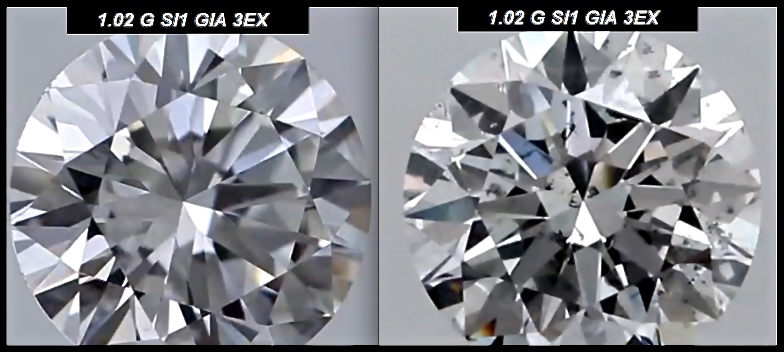
- The other major area is the clarity grade doesn’t take into account how the actual inclusions visually affect the look of the stone. It’s much better to have clear or white inclusions than dark inclusions, and where they are inside the stone, the closer to the middle the lower the grade, this is exactly how the different types of clarity grading work. The location, size and colour of the inclusions affect the grade of clarity, which in a perfect world would be graded correctly every time.
However, the sad reality is the clarity grade is looked at and graded by fallible humans. I have seen it all …. knowledge is power, I can help educate you and get you the best stones.
Clarity example, both are graded identically – but look very different.